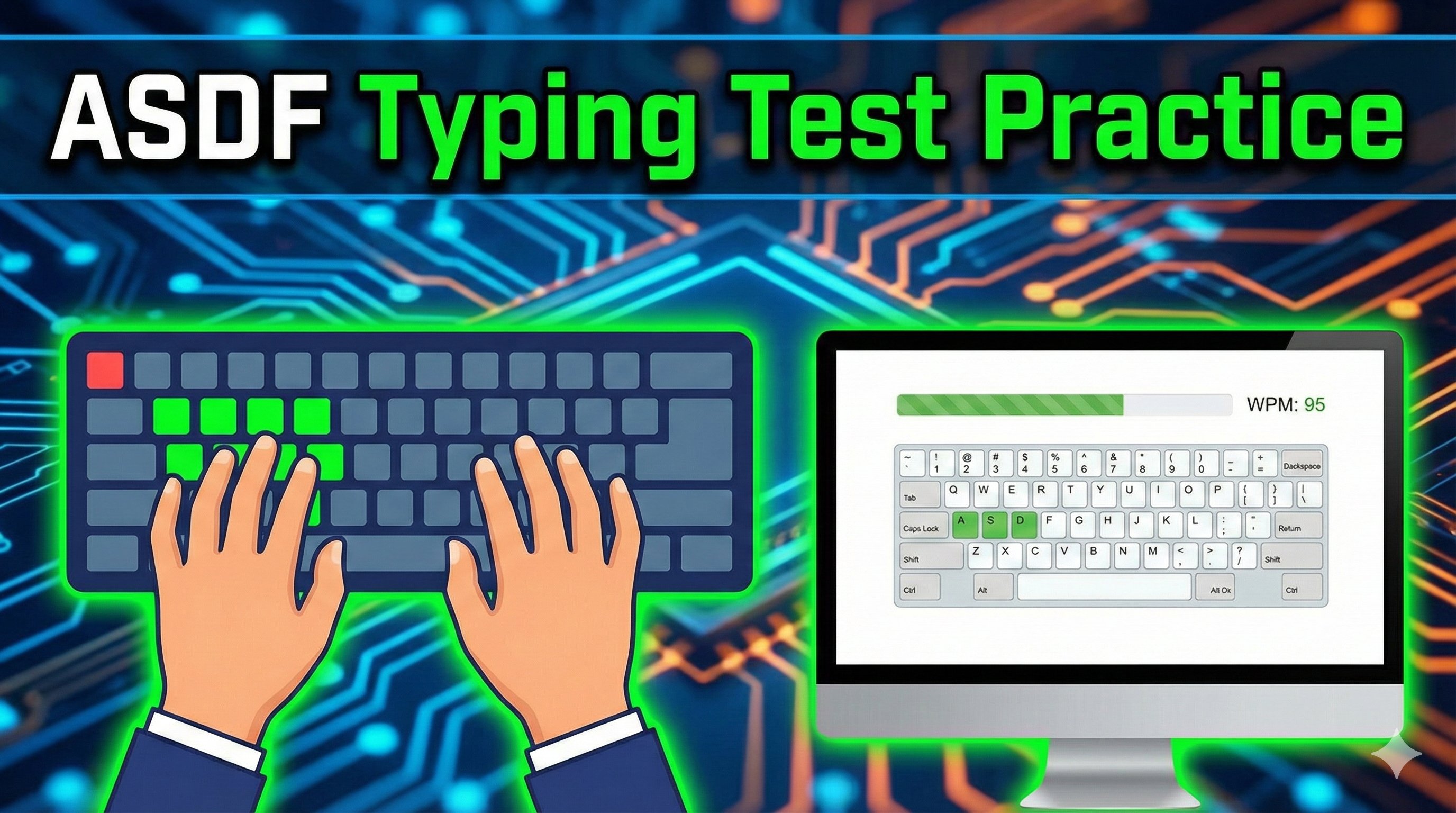
Chapter 1: ASDF Typing Test Practice
Typing Setting & Analysis
ASDF Typing Test Practice Set for Government Exams: Build Speed, Accuracy, and Real Exam Confidence
Typing tests are a crucial part of many government recruitment processes. Whether you are preparing for clerk-level posts, data entry roles, stenographer-related typing rounds, or other computer-based exams, one thing is common: you must type fast and accurately under pressure. Many candidates focus only on GK, reasoning, or math, but typing is a skill-based round—if you ignore it, your selection can stop at the final step even after clearing written exams.
To solve this problem in a practical and beginner-friendly way, I created an “ASDF Typing Test Practice Set” that helps candidates build a strong typing foundation from the most basic level. This practice set is designed especially for government exam typing preparation, where consistent daily practice is more important than random long paragraphs. The goal is simple: start from controlled keys, improve finger placement, reduce mistakes, and gradually reach a stable speed that works in real exam conditions.
Why ASDF Practice Matters in Typing Preparation
Most typing mistakes happen because fingers do not return to the correct position. In standard touch typing, the left hand rests on the home row keys: A, S, D, and F. These keys are not just random letters—they are the foundation of correct hand placement. When your fingers learn where these keys are without looking, your hands become stable, and speed improves automatically.
Government typing tests usually check two main things: speed and accuracy. Many candidates try to increase speed too early and end up making too many errors. This lowers accuracy and creates panic during the test. ASDF practice helps control the hands and trains muscle memory. When muscle memory becomes strong, the candidate types smoothly without thinking about every letter.
What I Built: A Dedicated ASDF Typing Test Practice Set
I created a structured ASDF practice set to make typing practice systematic instead of confusing. Many typing websites or random practice paragraphs do not focus on step-by-step training. They assume you already have control. But a large number of candidates start typing preparation from zero or from a very weak base. That is why my ASDF practice set is designed like a training path.
In this practice set, you repeatedly type combinations using only the ASDF keys. This removes distraction and forces your fingers to learn correct movement and return to home position. Over time, the practice increases difficulty: from single-letter repetitions to pair combinations, then groups of four, and then longer patterns. This approach builds confidence because you can clearly see improvement without feeling overwhelmed.
How This Helps for Government Exam Typing Rounds
Government exams that include typing rounds often have strict qualifying conditions. Some exams demand a minimum speed (words per minute) and also evaluate accuracy. Even if the exact speed requirement differs by exam, a candidate must develop reliable performance. My ASDF practice set supports this by training the most essential part of typing: hand stability and key familiarity.
When you master ASDF control, it becomes much easier to expand to other keys like JKL; for the right hand and then gradually to the full keyboard. In simple terms, ASDF is where your left hand becomes disciplined. Once this discipline is built, moving to complete sentences and paragraphs becomes much faster and less stressful.
Beginner-Friendly, But Useful for Everyone
This typing practice set is not only for absolute beginners. Even candidates who already type at a moderate speed often suffer from inconsistency—some days they type well, other days speed drops and errors increase. That inconsistency usually comes from weak fundamentals. Revisiting ASDF training improves control and reduces error rate, which directly improves final effective speed in exams.
Another advantage of this focused practice is that it reduces the habit of looking at the keyboard. Many candidates keep glancing down while typing, which wastes time and breaks rhythm. With ASDF-only drills, you naturally stop looking because the keys are close and repetitive. This builds the habit of typing by feel, which is essential in timed tests.
Designed for Daily Practice and Long-Term Improvement
Typing is like fitness: you cannot build it in one day. It grows with regular training. My ASDF practice set is designed so that a candidate can practice daily in a short time and still make strong progress. Instead of long complicated passages, the set focuses on repetition with purpose.
For example, if you practice ASDF drills for 15–20 minutes daily, you start noticing improvements in a week. After that, you can add the next keys gradually and build full typing skill. The biggest benefit is that the practice feels structured, so you don’t waste time deciding what to type every day.
How to Use the ASDF Practice Set Effectively
To get the best results, typing practice must be done correctly. Here are the habits that work well with this ASDF practice set:
1) Focus on accuracy first: Do not chase speed on day one. Try to type clean and correct. Speed will come naturally when errors reduce.
2) Maintain correct finger placement: Keep your left hand on A-S-D-F position. Avoid random finger movement. Train the correct fingers for the correct keys.
3) Keep a steady rhythm: Instead of typing too fast and then stopping, aim for a smooth flow. Government typing tests reward stable performance.
4) Practice in small sessions: Long sessions can cause fatigue and more mistakes. Short daily practice is better than one long weekly practice.
5) Track progress: Notice your error reduction, comfort level, and consistency. Improvement is not only WPM; it is also control.
Why a Practice “Set” Is Better Than Random Typing
Many candidates open any typing website and start typing whatever comes on screen. This looks like practice, but it often fails to build fundamentals. A practice set gives direction. It ensures you master one stage before moving to the next. This is important in exam preparation because time is limited and progress must be measurable.
My ASDF practice set acts like a foundation course. Once candidates feel comfortable, they can move forward to JKL; and then to ASDF + JKL; and then to full words, sentences, and paragraph typing. This staged growth is exactly how touch typing skill is built, and it aligns perfectly with government exam needs.
Confidence Matters in the Exam Hall
A typing test is not only about skill; it is also about confidence under pressure. In exams, candidates often panic when they make small mistakes. They start using backspace too often or lose rhythm. The best way to avoid this is to train so well that your hands automatically know what to do.
ASDF drills create that automation. When your fingers move confidently, your mind stays calm. This calmness improves performance and helps you complete the test comfortably.