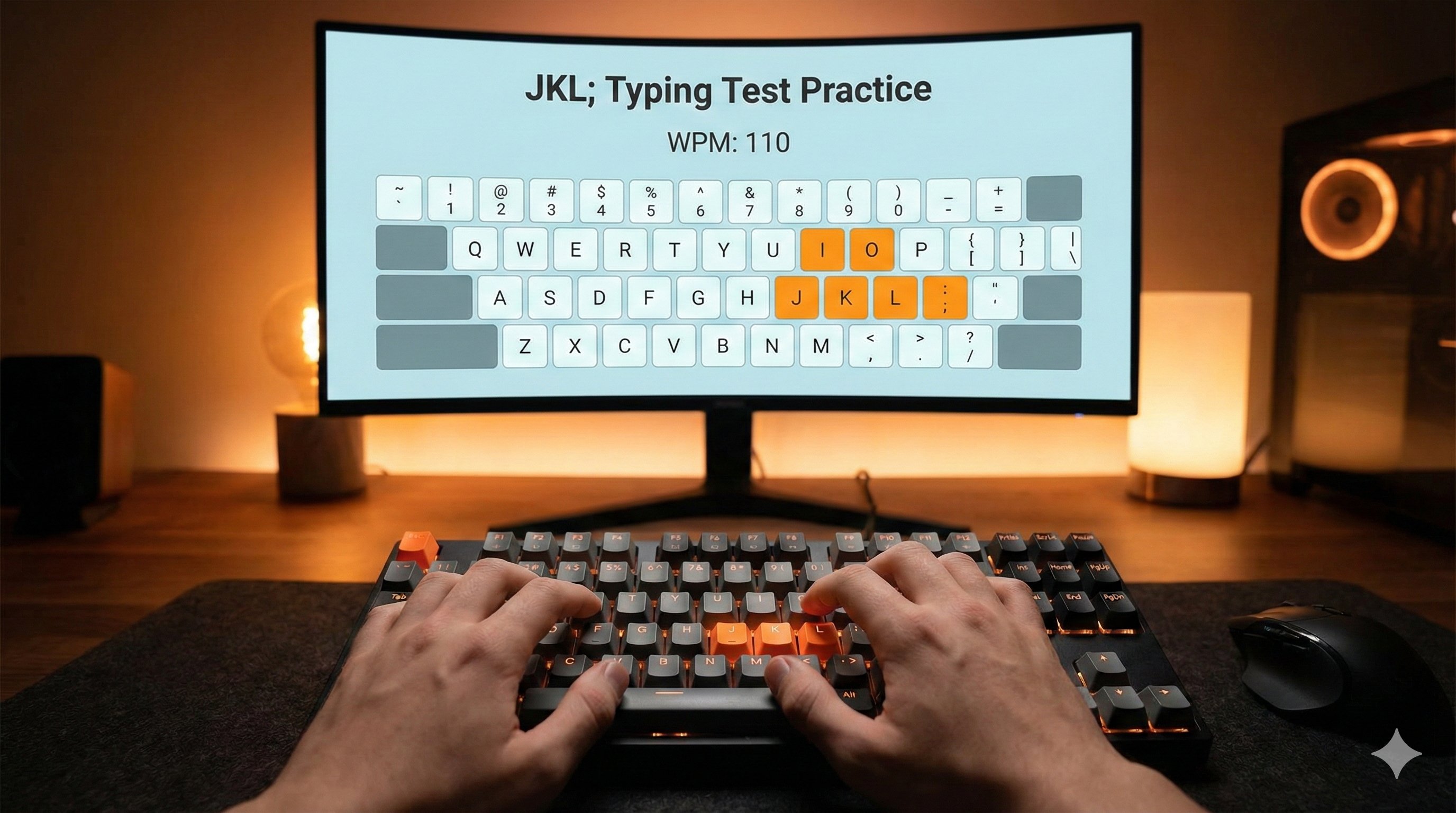
Chapter 2: JKL; Typing Test Practice
Typing Setting & Analysis
More Practices
Chapter 2: JKL; Typing Test Practice – Strengthening the Right Hand for Government Exams
After building a strong foundation with ASDF typing practice, the next logical and essential step in typing preparation is mastering the right-hand home row keys: J, K, L, and the semicolon (;). Chapter 2 of the typing practice series focuses entirely on JKL; Typing Test Practice, which plays a crucial role in developing balance, coordination, and accuracy in both hands. For government exams that include typing tests, this stage is just as important as the first one.
Many candidates unknowingly struggle with right-hand control. Even if the left hand is well-trained, weak right-hand fundamentals can slow down overall typing speed and increase errors. That is why a dedicated JKL; practice set is necessary. This chapter is designed to train the right hand in the same systematic, disciplined way as ASDF trained the left hand.
Why JKL; Keys Are Critical in Touch Typing
In standard touch typing, the right hand rests on the home row keys J, K, L, and ;. The index finger stays on J, the middle finger on K, the ring finger on L, and the little finger on the semicolon. The J key usually has a small raised bar, which helps typists find the correct position without looking at the keyboard.
Government typing tests require continuous typing for a fixed duration. If the right hand is not comfortable with its home row, fingers drift away, leading to wrong key presses and frequent corrections. JKL; practice builds positional awareness and trains fingers to return to the correct keys automatically after each keystroke.
What Chapter 2: JKL; Typing Test Practice Is Designed For
This chapter is created as a focused training module rather than random typing content. The main purpose is to strengthen right-hand finger movement, accuracy, and rhythm. Just like ASDF practice isolates the left hand, JKL; practice isolates the right hand. This separation helps the brain and muscles learn independently before combining both hands.
The practice set begins with simple repetitions of J, K, L, and ; to establish comfort. It then moves to controlled combinations like JK, KL, L;, and longer patterns such as JKL; or ;LKJ. This gradual progression ensures that candidates do not feel rushed and can clearly notice improvement.
Importance of the Semicolon (;) in Exam Typing
Many candidates ignore the semicolon during early practice, but this is a common mistake. In several government typing tests, punctuation marks are included in the passage. The semicolon is typed using the right-hand little finger, which is often the weakest finger. If it is not trained properly, it becomes a source of frequent errors.
Including the semicolon in Chapter 2 ensures complete right-hand readiness. It trains the little finger to move confidently without disturbing the rest of the hand. This small detail can make a big difference in real exam performance, where even minor hesitation can break typing flow.
How JKL; Practice Improves Speed and Accuracy
Typing speed is not just about moving fast; it is about moving correctly. When the right hand becomes stable on JKL;, keystrokes become cleaner and more predictable. This reduces the need for backspacing and corrections, which directly improves effective speed.
Accuracy improves because fingers learn exact distances and movements. Instead of guessing where a key is, the fingers move with certainty. Over time, this certainty develops into muscle memory. Once muscle memory is established, typing becomes automatic, which is exactly what is needed in timed government exams.
Common Problems Faced by Candidates Without JKL; Training
Many candidates skip right-hand-specific practice and move directly to full paragraphs. This often leads to uneven typing performance. Some common issues include frequent mistakes on L and ;, excessive use of backspace, right-hand fatigue, and loss of rhythm during long passages.
Another major issue is imbalance. If the left hand is stronger than the right, typing speed becomes inconsistent. The brain has to slow down to allow the weaker hand to catch up. Chapter 2 JKL; practice solves this imbalance by giving equal importance to the right hand.
Ideal Way to Practice JKL; Typing Daily
Consistency matters more than duration. Practicing JKL; typing for 15 to 20 minutes daily is enough to see noticeable improvement. The key is to practice with focus and correct posture. Sit comfortably, keep wrists relaxed, and avoid looking at the keyboard.
During practice, candidates should aim for smooth and steady typing rather than bursts of speed. If a mistake happens, it is better to slow down slightly and regain rhythm instead of panicking. This habit directly helps during the actual exam.
How Chapter 2 Prepares You for the Next Stages
Chapter 2 is not an isolated exercise; it is a bridge to advanced typing practice. Once ASDF and JKL; are mastered individually, combining both hands becomes much easier. The fingers already know their positions, so coordination develops naturally.
After completing JKL; practice, candidates are ready to move to mixed drills such as ASDF + JKL;, followed by full-word and sentence typing. Without mastering Chapter 2, these later stages often feel difficult and frustrating.
Psychological Benefits of Structured Typing Practice
Typing tests often create anxiety because they are qualifying in nature. One small mistake can feel disastrous. Structured practice like JKL; drills builds confidence. When candidates know that their right hand is well-trained, they feel more relaxed during typing tests.
This confidence reduces exam stress and improves concentration. Instead of worrying about keys, the mind focuses on maintaining pace and reading the text correctly. Calm typing almost always leads to better scores.
Why This Practice Is Especially Useful for Government Exams
Government exams value reliability. They do not require extraordinary typing speed, but they do require consistency and accuracy. JKL; typing practice helps candidates reach a safe and dependable performance level. It reduces silly mistakes that can otherwise disqualify a candidate.
Since government exam preparation already demands long study hours, typing practice must be efficient. Chapter 2 is designed to give maximum benefit in minimal time by focusing on core skills rather than unnecessary complexity.